Saturday, March 18, 2017

P.C.C.M. #29 B

Yard work for Penn Central Car Movement  #29 continues at West Mill to assemble the next train to Selkirk (WMV-5) with cars that will be transferred to Terminal Yard on the New York Central Train Layout.

A block of these cars will be transferred to the Long Island Railroad after reaching Terminal Yard.  Creating the block first requires separating this NYC covered hopper from some of the cars headed to the L.I.R.R.


The covered hopper is set out of the way and the Illinois Central car bound for Pilgrim State Hospital via the L.I.R.R. is coupled onto two gons of steel plates that will be headed to Mid Island Steel, also via the L.I.R.R.


The next car to be added to the L.I.R.R. block is this BAR car loaded with Cavendish Foods packaged meals, also for Pilgrim State Hospital.
 
The car is cut and moved toward the L.I.R.R. block.


The BAR car coupled onto the L.I.R.R. block, the auto parts cars including NYC #53051, seen below, are moved back to track 3 and coupled onto the rest of the cars for WMV-5.


The last move to complete assembly of the L.I.R.R. block involves this P&E car loaded with soft drinks for Pilgrim State Hospital.


It is pulled from Track 3 and set out on Track 1 with the rest of the block.

The L.I.R.R. block now fully assembled, the switcher pulls the other cars from Track 3.....


...and backs them into the L.I.R.R. block on Track 1.


The switcher and transfer caboose cut off from the cars on track 1 to clear the way for the train's assigned consist to pick it up for departure.


 Power for WMV-5 this time is FP7 #4362 and F7A#1805


The consist will soon couple up to the cars on Track 1 to officially make it WMV-5.

Latest Penn Central Car Movement (P.C.C.M. #29)

Continuing the "virtual ops" with the New York Central Train Layout, the Kings Port Division is setting up a train at West Mill with cars for the N.Y.C.T.L.'s Terminal Yard to be moved via Selkirk Yard.

Crewmen on a pair of transfer cabooses exchange greetings as the yard switcher begins to assemble WMV-5.


Cars currently on track 1 include EL #73510 loaded with bagged cement from Booms Ready Mix for Neal's lumber 


PC #77047 with bags of GERN Cement Flux  for  Neal's Lumber, and IC #30130  loaded with packaged cake mix from Blue Ribbon Flour for Pilgrim State Hospital.


Gons with steel plates from KP Steel for Mid Island steel


An NYC covered hopper load of flour from Blue Ribbon for Hostess/Wonder Bread.


An empty TP&W boxcar for Walsh Steel Wool and a P&E car loaded with Woodstock Hills Natural Soda for Pilgrim State Hospital.   


Meanwhile Track 3 contains:

Three 60 foot auto parts cars from ACME Auto Parts for Ford


A BAR car loaded with Cavendish meals for Pilgrim State Hospital and one NYC 50 foot double door car loaded with washing machines from Peerless Appliance for All City Storage


A B&M 50' RBL car loaded with window glass for Universal Milling to add frames, and two empty hoppers for Hudson Coal as an empty request from Corning Glass for its power house.


Cars will soon be appropriately blocked to expedite delivery.

Sunday, March 5, 2017

KarTrak ACI on the Kings Port Division

I made reference to an ACI (Automatic Car Identification) scanner in my previous post.   If you read my New Year's Resolution post you know I planned to add ACI labels to all of my rolling stock this year.  I hadn't planned to make scanners to compliment those labels but the serendipitous discovery of the video below gave me a great look at an ACI scanner in action during the PC era!

The video is a very optimistic 1968 view of the future fortunes of the Penn Central.  Its fun to watch and at 10:49 you'll see some nice footage of cars with ACI labels rolling by a scanner.

 https://www.youtube.com/watch?v=IPlLt1Wsor0

After seeing that, I did some internet searching to find images of similar ACI scanners but didn't come up with much, so I used the image in the video as a guide to scratch building one.  I drew a quickie sketch for reference and then used readily available materials to cobble one together.   The upright pole and cross bar is a cut down telegraph pole.   The other components are made from scrap styrene and a bit of wire.


I made a second one, this time with a longer post that extends below the base.  I figured drilling a hole for the post would secure it more easily on the layout.


The scanners after painting.

Here is one installed at West Mill.   The photo is an attempt to emulate the scene in the PC video.


I installed a second scanner at the other end of West Mill Yard.

...and a third in Kings Port near Williams Yard (staging)


I've also been gradually adding more ACI labels to cars.  I did purchase the Microscale ACI Plates decal sheet (MC-4280 for HO) and yesterday added labels to at least two dozen cars.   Still plenty of labels left for the rest of my roster!

The informational sheet that comes with the decals provides great information about the background of ACI, specifically the KarTrak system that was developed by Sylvania and put into use in 1967.  Automatic Car Identification is a general name for such systems.  The information sheet also provides diagrams indicating appropriate placement of the ACI plates on freight cars.  The scanners apparently were able to read plates located within a fairly wide range along the sides of rolling stock, so variation from road to road or car to car is not unprototypical.

The informational sheet also referenced articles about KarTrak in the July and December 1969 Model Railroader magazines, and an article about building an ACI scanner found in the November 1994 issue.   I wasn't aware of that when I forged ahead and built my own scanners just using the video image as a guide!   I'll see if I can find that issue at a train show.

The use of the KarTrak labels was discontinued by 1977 because it was found that the dirt that naturally accumulated on cars interfered with the scanner's ability to read them.   But, as a Penn Central era layout, the Kings Port Division is right up to date with the technology!


Wednesday, March 1, 2017

Return to "virtual ops"; P.C.C.M. 28

My Kings Port Division and John's New York Central Train Layout continue the "virtual ops" scheme into 2017.  For those unfamiliar with what we're doing, we arrange freight car movements from each others freight yards to each others industries.   Its "virtual" because our layouts reside in basements over 1000 miles apart and we don't actually send each other cars...we photograph and sometimes video trains with identical rolling stock that we happen to own, creating the impression of movement from one layout to the other.  Since starting the Penn Central Car Movement  (P.C.C.M.) series we've added to our mutual rosters and now have some 40 cars in common, which provide a lot of variety in operations.

We are currently in the middle of the 28th exchange of cars since starting over a year ago.  We occasionally share these exchanges in our respective blogs.

The New York Central Train layout recently dispatched Train LS-1 from its Terminal Yard to Selkirk with a block of cars destined for West Mill Yard on my layout.  See the action here:

 http://newyorkcentrallayout.blogspot.com/

We use Selkirk Yard as an intermediate destination where cuts of cars for our respective layouts are placed in new trains that can be photographed "arriving".  This gives us the freedom to use different motive power on the trains since we don't own that many locomotives in common.

Anyway, LS-1 has reached Selkirk and cars for West Mill have been cut from it and tacked onto VW-2 (Selkirk to Weehawken) which will stop at West Mill and drop them off before continuing southbound.

On the Kings Port Division VW-2 is seen crossing Ulster Ave in Kings Port, north of West Mill.   The consist at the head end is a local railfan favorite F7A and GP9B.


The red signal indicates the arrival of VW-2 at West Mill where it passes in front of the newly installed ACI scanner near WM tower.  (More on that in a future post)

The cut of cars for West Mill starts with a P&LE boxcar right behind the locomotives and ends with the NYC 86 ft. auto parts car seen below.  Freight cars behind the auto parts car will "continue to Weehawken" (i.e. go into staging).

The train stops near the modern West Mill Yard Tower, the cut for the yard is uncoupled, and then pulled ahead.


Once the enormous auto parts car clears the switch, the cut of cars for West Mill is pushed backward into the arrival track.


The cut for West Mill is in the foreground while the rest of VW-2, awaiting the return of its motive power, is immediately behind it.

The F7A/GP9B return to the mainline and couple up with VW-2.


Having received clearance to proceed, VW-2 gets underway...


Yard hog SD9 #6922 gets the call to move the cut into West Mil Yard for sorting into two trains: a transfer run to Mayfield that will be picked up by the Kings Port & Western RR., and The Kings Port Turn which will serve local industries.

That's plenty for now!  Thanks for taking a look!
 

Sunday, February 5, 2017

One Resolution met!

Hi all,

While thousands of people are probably finding it harder and harder to stick to New Year's Resolution diet and exercise programs by now, I am happy to report that I actually met one of my Layout Resolutions...the development of a locomotive servicing track at West Mill Yard.

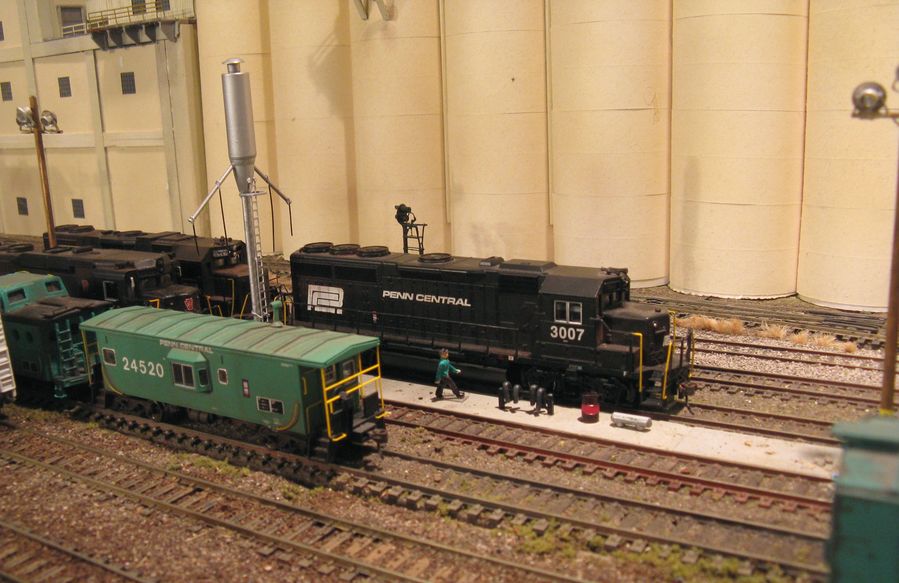
This included the construction of a sand tower and a fueling facility for my PC and KP&W locos.

I started with the sand tower first and built it using common place, every day items.   I know there are some excellent sand tower kits out there, but part of the fun of the hobby for me is to see what I can fashion from inexpensive materials.

Here is the new sand tower in place at West Mill.

And here is a short, hopefully humorous, video describing its construction.
https://www.youtube.com/watch?v=sl1XjrI7A8I&t=61s

 I added miscellaneous "ersatz" details to the servicing track area such as this suggestion of a rack for MU hoses.
 
...and then followed up the sand tower by adding diesel fuel and oil tanks, and a fueling station.

The loco track was originally electrically isolated as one block but I subdivided it into three to accommodate three locos or consists.  This will allow me greater operations potential at the servicing track.  The block divisions are marked by the light poles.

One

Two

Three!

Well, that's one resolution down!  Now its time to call out some power assignments!

Thanks for reading!

Sunday, January 8, 2017

New Year's Resolutions

Hi all!

Happy New Year!

Its the traditional time for making resolutions but instead of the usual "eat better, lose weight, and be more active", I'm making a few regarding model railroading and the layout.   The nice part about this is that my resolutions are all about having fun instead of being more self-disciplined!

Well, it will take a little self-discipline to meet some resolutions such as adding more ACI labels to my rolling stock.  Tasks like that can be a bit monotonous but yield satisfying results in the end...sort of like exercising...but I can snack while doing it!  :)   First obvious step will be to actually obtain a MicroScale ACI decal sheet at my local hobby shop.   Then I can add them to freight cars gradually over time.


Next resolution is to develop a small locomotive service area at West Mill Yard.   After expanding the yard last year with three long tracks, I'm planning to convert the two tracks that made up the original West Mill Float Yard into locomotive and caboose tracks.


I want to include a sand tower in the scene...something along these lines:

Since I'm operating with traditional DC I'll need to cut some power blocks to accommodate having more than one locomotive consist waiting for assignment on the loco track.

Speaking of which....I have already met one of the resolutions I was going to include in this post...creating a way for locomotives to escape the arrival yard track at West Mill.  As this picture illustrates, trains coming from the right side of West Mill Yard (from the north) roll into the yard and the consist is stuck behind its cars at the end of the stub ended yard.   

I recently solved that problem as described in the attached video:
https://www.youtube.com/watch?v=523faMG-nEE

Other resolutions include continuing to make sure all rolling stock is reliable (i.e. free rolling, standard coupler heights, etc).  This is another of those not-quite-as-fun but definitely worthwhile resolutions that I'll be doing throughout the year.

I'd also like to develop a Kings Port & Western unit coal train using the decals I had printed last year to label the cars....and also make a string of KP&W stock cars.  I'm planning on obtaining the rolling stock at train sales if possible. 

Another thing I'd like to do is take a good long look at structures and scenes on the layout and see what I might be able to improve.    I've found that taking photos of the layout is a great way to get a more objective view of my work...one that often motivates improvements.

And finally, I resolve to continue to have fun and enjoy the camaraderie of the hobby!

Happy New Year and best wishes to all!